You wake up. It’s dark. You hear a soft humming — fans, somewhere.
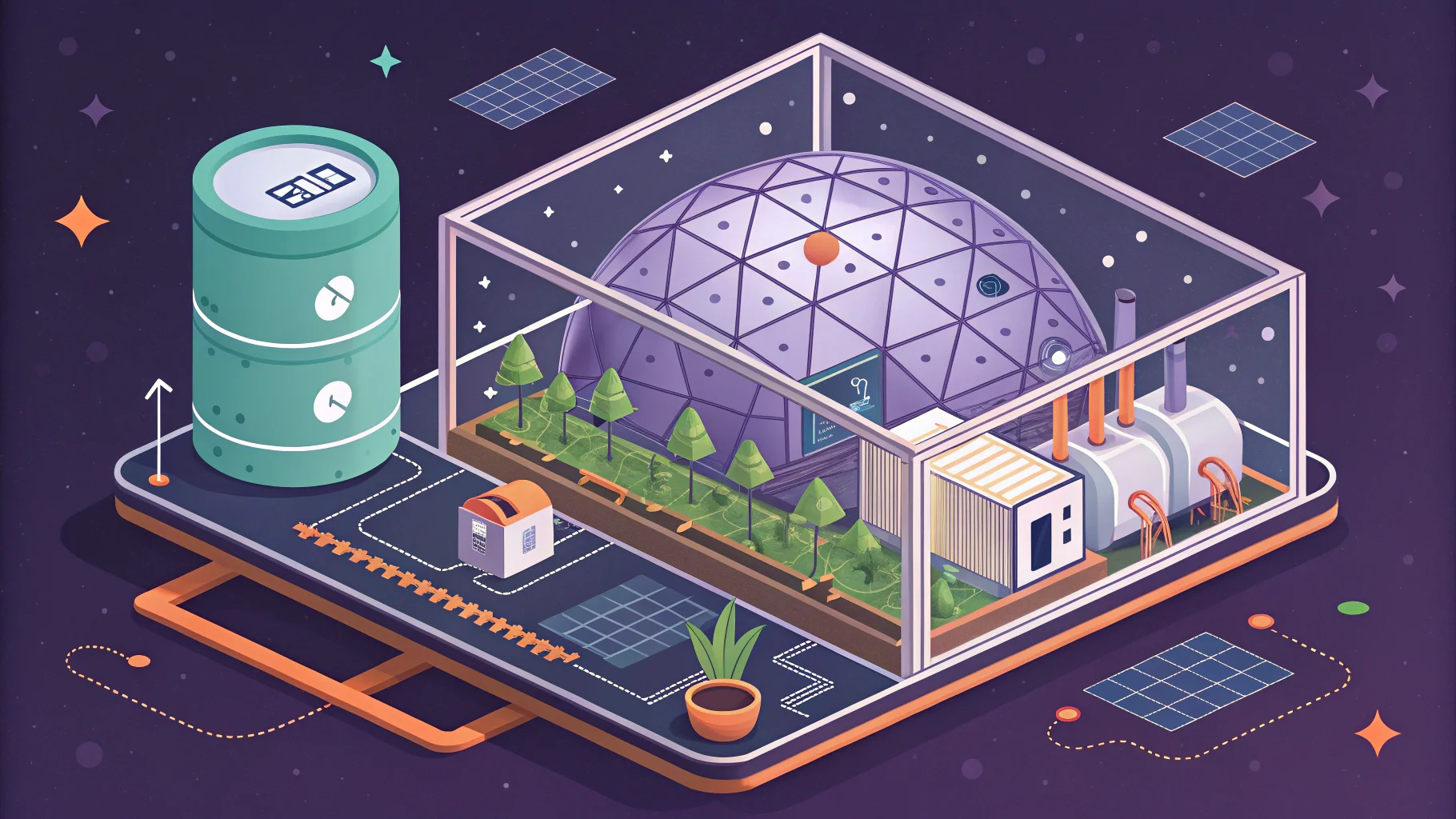
Slowly your eyes adjust to the light. You find yourself in a container. Metal walls, a few windows looking out at… stars. Only stars. No Earth in sight.
There’s a note:
“You have everything you need to survive. Nothing goes in, nothing goes out. Good luck.”
This is the thought experiment I regularly discuss when I’m in a philosophical mood with friends. It sounds like science fiction, but it’s actually a lens to think about systems thinking, circular processes, and — if you extrapolate — about how we treat the Earth.
The problem
In your space container you have several fundamental needs:
- Oxygen to breathe
- Water to drink
- Food to eat
- Waste processing — because what goes in, also comes out
- Energy to keep everything running
- Temperature regulation — space is cold
In a normal system on Earth we “solve” these problems by getting resources from outside and sending waste outside. Turn on the tap, water. Supermarket, food. Flush the toilet, problem solved.
But in your container there is no “outside”. Everything you exhale must become oxygen again. All the water you drink, you must recover. Every scrap of food counts.
This is a closed system. And closed systems force you to think fundamentally differently.
What would you do?
Let’s walk through it step by step.
Oxygen and CO2
You breathe in oxygen and breathe out CO2. After a few hours the air in your container is unlivable — unless you do something.
Option 1: Plants
Plants do photosynthesis: they absorb CO2 and produce oxygen. Perfect, right?
The problem: you need a lot of plants. Estimates vary, but for one human you need somewhere between 300 and 700 plants, depending on type and light intensity. And those plants need light — so energy.
Option 2: Chemical scrubbers
This is what the ISS does. They use lithium hydroxide (LiOH) or zeolite to filter CO2 from the air. The downside: lithium hydroxide runs out. Zeolite can be regenerated with heat, so that’s better for a closed system.
Option 3: Sabatier reaction
The ISS also uses the Sabatier reaction: CO2 + hydrogen → methane + water. The hydrogen comes from electrolysis of water. The methane is (unfortunately) vented to space — so that’s a leak in the system. But the water can be reused.
In your perfect closed system you’d want to convert that methane to something useful. That’s difficult, but not impossible.
Water
You continuously lose water: sweat, breath, urine, feces. In a closed system all that water must come back.
The ISS does this with the Water Recovery System (WRS):
- Urine Processing Assembly — yes, they drink recycled urine. The water is distilled and filtered until it’s cleaner than tap water.
- Condensate — the humidity in the air (from sweat and breathing) is condensed and filtered.
The recovery rate is about 93%. The other 7% is lost and must be resupplied. In your perfect system you’d want 100%.
Food
This is where it gets difficult.
Plants can produce food, but they need:
- Light (energy)
- Water
- Nutrients (nitrogen, phosphorus, potassium, etc.)
- CO2
Those nutrients — that’s where the problem lies. In a closed system you must compost human waste and convert it back to plant food. That’s biologically possible (composting, vermicomposting with worms), but it takes time and space.
The ISS doesn’t do this — they receive food supplies from Earth. But experiments like MELISSA (Micro-Ecological Life Support System Alternative) from ESA research how you could create a completely closed food cycle.
The reality: for complete self-sufficiency you need a fairly complex ecosystem. Not just plants, but also bacteria, fungi, maybe insects or fish for protein.
Energy
Solar panels are the obvious choice. The sun always shines (no clouds in space).
But you need storage for when you’re in shadow. Batteries, or perhaps flywheels for kinetic storage.
Nuclear energy is an option — RTGs (Radioisotope Thermoelectric Generators) are used in deep space missions. But those also run out (over decades).
Temperature
In the sun: blindingly hot. In shadow: -270°C.
The ISS uses a combination of:
- Insulation — multi-layer insulation
- Radiators — dissipating heat to space
- Heat pumps — moving heat around
You can’t “throw away” heat without losing it. In a closed system you want to reuse heat as much as possible.
The lesson: feedback loops
What fascinates me about this thought experiment is how it forces you to think in feedback loops.
In an open system you think linearly:
Input → Process → Output → (somewhere else)
In a closed system you think circularly:
flowchart LR
    Input --> Process --> Output --> Recovery --> Input
Every output must become an input for something else. Waste doesn’t exist — only resources in the wrong place.
This is exactly how systems thinking works. You don’t look at individual components, but at the relationships between components. At what goes in, what comes out, and how those flows connect to each other.
Buckminster Fuller’s Spaceship Earth
In 1968 Buckminster Fuller wrote the book Operating Manual for Spaceship Earth. His central thesis: Earth is a spaceship. A closed system with finite resources, floating through the universe.
“We are all astronauts on a little spaceship called Earth.”
The difference from my thought experiment: Earth is big enough that we don’t feel the limits. We can pretend “outside” exists — as if we can dump waste without consequences, extract resources without depletion.
But the rules are the same. There is no “away” for plastic in the ocean. There is no infinite supply of fossil fuels. The CO2 we emit stays in the system.
Downscaling to a container makes this tangible. Suddenly it’s personal. You have to breathe that air. You have to drink that water.
Why this relates to neurodivergence
For context about how my brain works, see Working with an AuDHD brain.
One of the things I’ve noticed about my way of thinking: I see systems. Not as a conscious choice, but as default. When someone presents me with a problem, I automatically zoom out to: “Where does this come from? Where does it go? What are the feedback loops?”
This can be overwhelming. Sometimes you just want a simple answer, not a systems analysis. But for this kind of thought experiment it’s perfect.
The reason I keep coming back to this experiment is that it’s a safe place to practice this kind of thinking. It’s abstract enough not to be stressful, but concrete enough to yield useful insights.
Practical applications
This is all philosophical, but there are concrete lessons:
1. Waste is a design flaw
If you produce waste that you can’t reuse, that’s a design flaw. In your container “waste” would kill you. On Earth it takes longer, but the principle is the same.
2. Efficiency is survival
In your container every drop of water is precious. Every watt of energy counts. You would never leave a tap running or a light burning. Why do we do that on Earth?
3. Complexity is fragile
The more complex your system, the more can fail. In your container you want robust, simple systems with redundancy. This is also why I’m a fan of GitOps and declarative configuration — simple, predictable systems you can understand.
4. Think in cycles, not lines
Most problems come from linear thinking: “I need this, I get it somewhere, I use it, done.” Circular thinking asks: “And then? Where does it go? How does it come back?”
Back to the container
So. You’re sitting in that container. Stars outside the windows. Everything you need is present.
What do you do?
You start with inventory. What do you have? Plants, seeds, water, a water purification system, solar panels, batteries, tools, compost bin, maybe an aquaponics system with fish.
You map out the flows. Oxygen, water, food, energy, heat. You identify the leaks — where are you losing resources? You optimize each cycle.
And slowly, methodically, you build a system that sustains itself.
That’s systems thinking. That’s what Buckminster Fuller meant. And that is, in essence, what we should be doing with Earth.
The only difference is the scale.
Further reading:
- Operating Manual for Spaceship Earth — Buckminster Fuller’s original essay
- ISS Environmental Control and Life Support System — NASA’s technical documentation
- MELISSA Project — ESA’s research into closed ecosystems
- Thinking in Systems — Donella Meadows’ classic on systems thinking