You wake up. It’s dark. Somewhere a fan is humming.
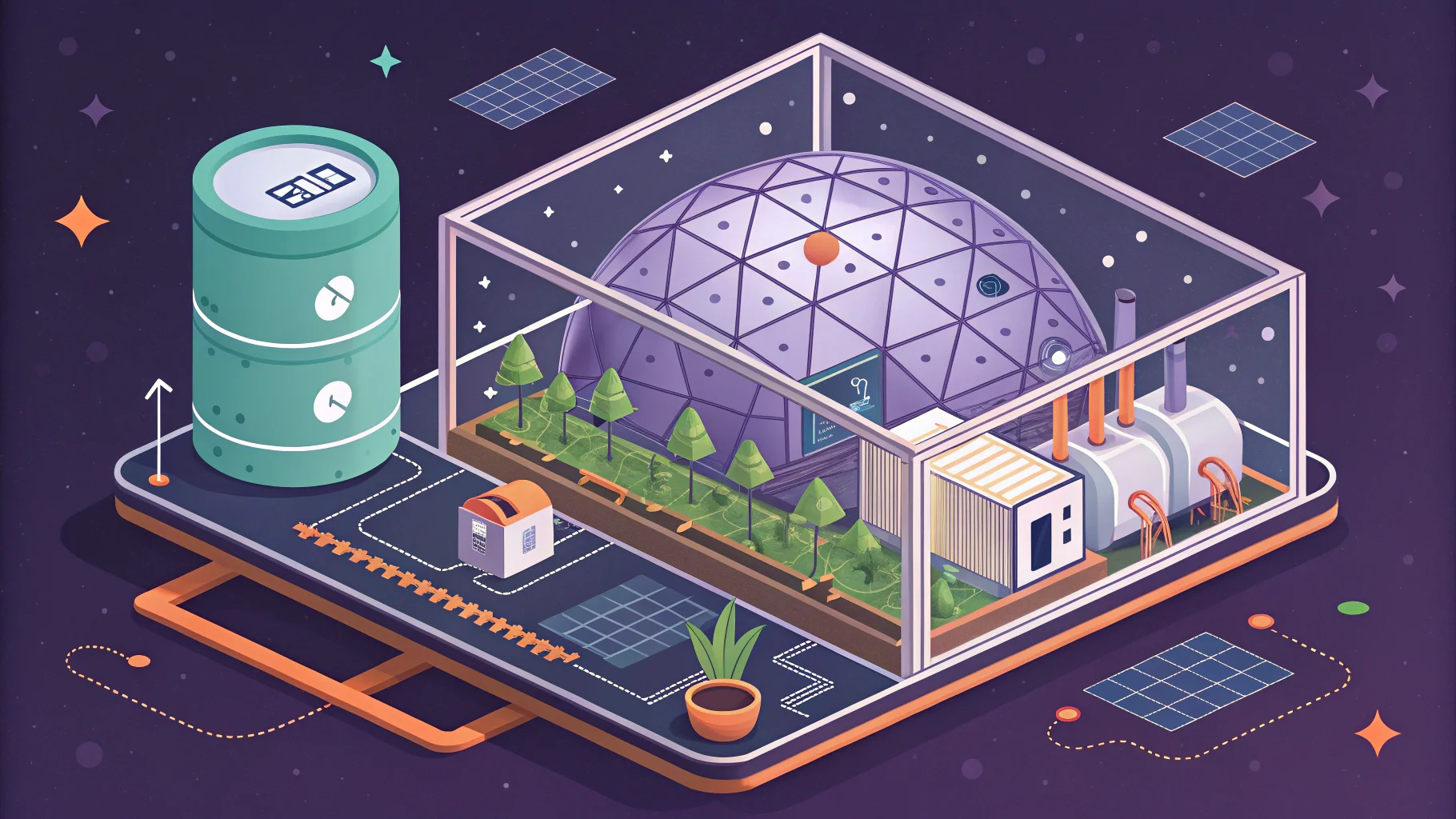
Your eyes adjust. You’re in a container. Metal walls, a few small windows, and through them: stars. Just stars. No Earth anywhere.
There’s a note taped to the wall:
“You have everything you need to survive. Nothing goes in, nothing goes out. Good luck.”
I bring this thought experiment up when I’m in the right mood with friends. It sounds like science fiction. What it actually does is strip away the thing most of us never question: the assumption that there is an “outside” that absorbs our mistakes and refills our supplies.
Life on autopilot
Back on Earth, you don’t think about any of this. You turn the tap and water comes out. You’re hungry, you go to the supermarket. You flush the toilet and the problem disappears, off to somewhere you’ve never seen and never have to think about.
That’s the comfortable version of living. Every need has a black box behind it. Water comes from a box. Food comes from a box. Waste vanishes into a box. You don’t have to understand any of them, because someone, somewhere, keeps them running for you.
It works right up until it doesn’t. And the trouble with depending on systems you’ve never looked inside is that when one fails, you have no idea why, and no idea what to do about it.
The container takes all those boxes away at once.
The moment the boxes disappear
In the container you have the same needs you’ve always had:
- Oxygen to breathe
- Water to drink
- Food to eat
- Waste processing, because what goes in also comes out
- Energy to keep everything running
- Temperature regulation, because space is cold
On Earth each of these is somebody else’s job. Here, every one of them is yours. There is no “outside” to pull from or dump into. Everything you exhale has to become oxygen again. Every drop of water you drink has to come back. Every scrap of food counts.
This is a closed system. And a closed system does something to your brain that an open one never does: it forces you to understand every single process you depend on, because your life is now riding on each of them.
That’s the part I keep coming back to. Not the survival mechanics. The shift in how you have to think the moment nothing is hidden from you anymore.
What would you actually do?
Let’s walk through it, because the details are where the realization sets in.
Oxygen and CO2
You breathe in oxygen, you breathe out CO2. A few hours in, the air goes bad. You have to do something about it, and “call the air company” is not on the table.
Option 1: Plants
Plants run photosynthesis: CO2 in, oxygen out. Sounds perfect.
The catch is the quantity. Estimates vary, but to keep one human breathing you need somewhere between 300 and 700 plants, depending on type and light. And those plants need light, which means energy.
Option 2: Chemical scrubbers
This is what the ISS does. Lithium hydroxide (LiOH) or zeolite pulls CO2 out of the air. The downside: lithium hydroxide runs out. Zeolite you can regenerate with heat, which is better for a closed system.
Option 3: the Sabatier reaction
The ISS also runs the Sabatier reaction: CO2 plus hydrogen gives methane plus water. The hydrogen comes from electrolysis of water. The methane gets vented to space, which is a deliberate leak in the loop. The water you keep.
In a perfectly closed container you’d want to turn that methane into something useful instead of throwing it overboard. Hard, but not impossible.
Water
You lose water constantly: sweat, breath, urine, feces. In a closed system, all of it has to come back.
The ISS handles this with the Water Recovery System (WRS):
- Urine Processing Assembly: yes, they drink recycled urine. Distilled and filtered until it’s cleaner than tap water.
- Condensate: humidity from sweat and breathing gets condensed and filtered back into the supply.
Their recovery rate sits around 93%. The remaining 7% is lost and has to be resupplied from Earth. In your container there is no resupply, so you’d be chasing that last 7% with everything you have.
Food
This is where it gets genuinely hard.
Plants can produce food, but they need light (energy), water, nutrients (nitrogen, phosphorus, potassium, and more), and CO2.
The nutrients are the sticking point. In a closed system you have to compost human waste and turn it back into plant food. Biologically that works (composting, vermicomposting with worms), but it costs time and space and patience.
The ISS sidesteps the whole problem by getting food shipped up from Earth. Experiments like MELISSA (Micro-Ecological Life Support System Alternative) from ESA are the ones actually trying to close the food loop completely.
The honest answer: full self-sufficiency needs a fairly complex ecosystem. Not just plants, but bacteria, fungi, maybe insects or fish for protein. A whole web, not a single crop.
Energy
Solar panels are the obvious call. No clouds in space, so the sun is reliable.
But you need storage for when you’re in shadow. Batteries, or maybe flywheels for kinetic storage.
Nuclear is an option too. RTGs (Radioisotope Thermoelectric Generators) power deep-space missions. They also run down, just over decades instead of hours.
Temperature
In direct sun: blistering. In shadow: -270°C.
The ISS uses a combination of:
- Insulation, multi-layer blankets
- Radiators that dump heat into space
- Heat pumps that move heat where it’s needed
You can’t throw heat away without losing it, and in a closed system you’d rather move it around than waste it.
What this does to your thinking
Here’s the thing that hooked me the first time I sat with this experiment. It forces you to think in feedback loops instead of straight lines.
In an open system you think linearly:
Input → Process → Output → (somewhere else)
In a closed system you think in circles:
flowchart LR
    Input --> Process --> Output --> Recovery --> Input
Every output has to become an input for something else. Waste stops being a category. There are only resources sitting in the wrong place.
That’s systems thinking in one sentence. You stop staring at individual parts and start looking at how they connect: what flows in, what flows out, and where the loops close or leak.
And it maps almost exactly onto how I think about infrastructure. When I run something myself, I want to know where every resource comes from and where it goes. A managed service is the tap on Earth: convenient, invisible, and a mystery the day it breaks. The container is my homelab. Nothing is hidden, everything is mine to understand, and that’s the whole point. I wrote more about why in Sovereign Infrastructure, but the container is the cleanest way I’ve found to explain the feeling.
Buckminster Fuller’s Spaceship Earth
In 1968 Buckminster Fuller wrote Operating Manual for Spaceship Earth. His core claim: Earth already is a spaceship. A closed system with finite resources, drifting through the universe.
“We are all astronauts on a little spaceship called Earth.”
The difference from my container is scale. Earth is big enough that we never feel the walls. We get to pretend “outside” exists, that we can dump waste without consequence and pull resources without running dry.
The rules don’t change with size, though. There’s no “away” for plastic in the ocean. There’s no infinite tank of fossil fuels. The CO2 we emit stays in the system with us.
Shrinking it down to a container is what makes it land. Suddenly it’s personal. You breathe that air. You drink that water. The black boxes are gone and the consequences have your name on them.
Why I think this way
For context on how my brain works, see Working with an AuDHD brain.
One thing I’ve noticed about myself: I see systems by default, not by choice. Hand me a problem and I’m already zooming out. Where does this come from? Where does it go? Where are the feedback loops?
It can be a lot. Sometimes a person just wants a quick answer and I’m three layers deep in second-order effects. But for this kind of thought experiment it fits perfectly, because the experiment rewards exactly the move my brain makes anyway.
I keep returning to the container because it’s a safe place to practice that thinking. Abstract enough to be low-stress, concrete enough to hand you something useful when you’re done.
What it leaves you with
It’s a philosophical exercise, but the takeaways are concrete.
1. Waste is a design flaw
If you produce something you can’t reuse, you designed a leak. In the container a leak kills you. On Earth it just takes longer to notice, but the principle holds.
2. Efficiency is survival
In the container every drop of water is precious and every watt counts. You’d never leave a tap running or a light burning. The only reason we do it on Earth is that the walls are far enough away to ignore.
3. Complexity is fragile
The more moving parts, the more that can break. In the container you want robust, simple systems with redundancy. Same reason I lean on GitOps and declarative configuration: simple, predictable systems I can actually reason about when something goes wrong.
4. Think in cycles, not lines
Most problems start with linear thinking: “I need this, I get it from somewhere, I use it, done.” Circular thinking keeps asking the next question. And then? Where does it go? How does it come back?
Back to the container
So there you are. Stars outside the windows. Everything you need already in the room with you.
What do you do?
You start with an inventory. What’s here? Plants, seeds, water, a purification system, solar panels, batteries, tools, a compost bin, maybe an aquaponics setup with fish.
Then you map the flows: oxygen, water, food, energy, heat. You hunt for the leaks, the places where you’re quietly losing resources. You tighten each loop until it closes.
Slowly, methodically, you build a system that keeps you alive without anything coming in or going out. By the time you’re done, there isn’t a single process in that room you don’t understand, because you couldn’t afford to leave one as a black box.
That’s systems thinking. That’s what Fuller was pointing at. And it’s roughly what we ought to be doing with Earth.
The only thing that changes is the scale.
Further reading:
- Operating Manual for Spaceship Earth, Buckminster Fuller’s original essay
- ISS Environmental Control and Life Support System, NASA’s technical documentation
- MELISSA Project, ESA’s research into closed ecosystems
- Thinking in Systems, Donella Meadows’ classic on systems thinking