“So what exactly is this zero trust thing everyone keeps talking about?”
I get this question a lot. Usually from managers, executives, or anyone who has to approve security budgets without a technical background. And honestly, most explanations I’ve seen are terrible. They’re either drowning in jargon or so oversimplified they’re useless.
So here’s my attempt at a metaphor that actually works. One that I’ve used successfully to explain zero trust to my parents, to executives, and to that one colleague who still thinks the firewall is “the internet box.”
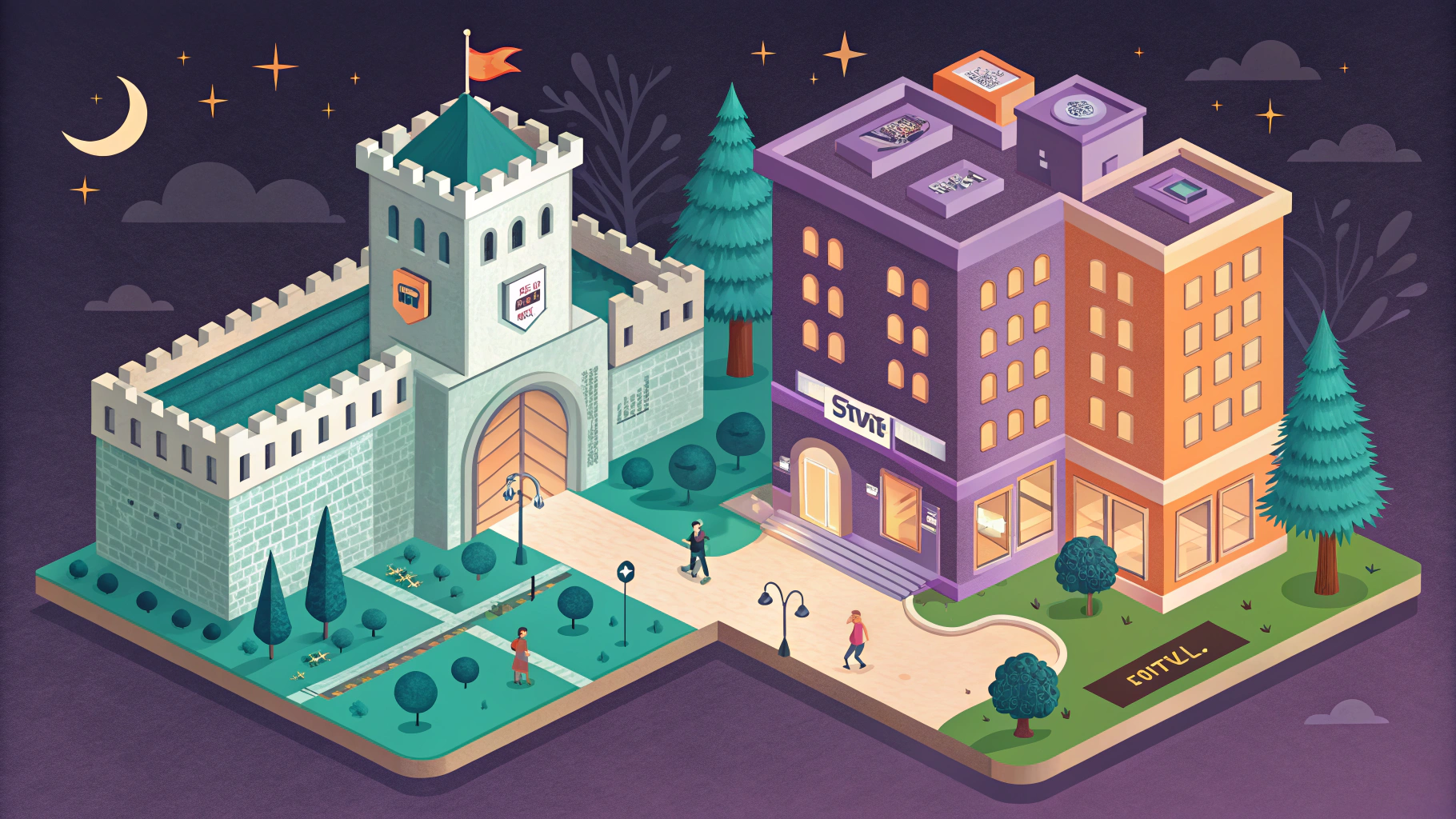
The Old Way: The Castle and Moat
Traditional network security works like a medieval castle. You build a big wall (the firewall), dig a moat around it, and put guards at the gate. Anyone outside the wall is untrusted. Anyone who makes it inside? They’re trusted. They can go anywhere, do anything.
This worked reasonably well when:
- Everyone worked in the same building
- All the servers were in the basement
- “Remote work” meant carrying a laptop home once a year
But then the world changed. People started working from coffee shops. Applications moved to the cloud. The castle walls became meaningless because half your kingdom was now outside them.
The castle model has a fatal flaw: once someone gets past the gate, they’re trusted. An attacker who compromises one laptop inside the network can move freely. This is how most major breaches happen — someone gets in through phishing, then moves “laterally” through the network because everything inside trusts everything else.
The New Way: The Hotel
Here’s where the hotel metaphor comes in. It’s the one that makes zero trust click for people.
Imagine a modern hotel. You check in at the front desk and get a key card. This key card:
- Opens your room
- Opens the gym (if your booking includes it)
- Opens the pool area (if your booking includes it)
- Opens the parking garage (if you registered a car)
- Does NOT open other guest rooms
- Does NOT open the staff areas
- Does NOT open the kitchen
Every single door makes its own decision about whether to let you in. The door doesn’t care that you’re “inside the hotel.” It only cares: “Does this specific key card have permission to open this specific door right now?”
That’s zero trust.
Why “Zero Trust” Is a Terrible Name
Let’s address the elephant in the room: the name is confusing. “Zero trust” sounds like you trust nothing and nobody, which is impractical and paranoid.
A better name would be “verify everything” or “continuous verification.” But we’re stuck with “zero trust,” so let’s work with it.
What it actually means:
- Don’t trust based on location (being inside the network)
- Don’t trust based on previous trust (you logged in once, so you’re forever trusted)
- Verify every access request, every time
- Give minimum necessary permissions
Back to the hotel: you’re not “untrusted.” You’re a verified guest. But your verification only grants you specific access to specific resources. And you reverify every time you open a door.
The Key Principles
Let me break down zero trust into its core components, still using our hotel:
1. Verify Explicitly
Every door checks your key card every time. You don’t get a wristband that says “trusted guest” and then get to walk through any door. The pool checks your card. The gym checks your card. Your room checks your card.
In tech terms: every access request is authenticated and authorized, regardless of where it comes from.
2. Least Privilege Access
Your key card only opens what you need. Booked a basic room? You get room access and common areas. Booked the executive suite with gym access? You get those too. But you never get access to other guest rooms or staff areas.
In tech terms: users get minimum permissions required for their role. An accountant doesn’t need access to source code. A developer doesn’t need access to HR records.
3. Assume Breach
The hotel is designed assuming that someone might get a key card they shouldn’t have. That’s why every door checks independently. If someone steals a key card, they can only access what that card allows — not the entire hotel.
In tech terms: design your systems assuming an attacker is already inside. Limit blast radius. Segment networks. Monitor everything.
A Day in the Zero Trust Hotel
Let me walk you through how this works in practice:
Morning: You wake up and want to go to the gym. You take your key card, walk to the gym door, and tap. The door checks: “Is this guest authorized for gym access? Is their booking still valid? Is the gym open right now?” Yes to all three — door opens.
Midday: You’re back in your room and want to order room service. You call, but they ask for your room number AND a security code that was on your check-in receipt. They don’t just trust caller ID.
Afternoon: You try to use the hotel’s business center printer. You need to authenticate again — your key card plus a PIN you set at check-in. Just having the card isn’t enough for some resources.
Evening: Your booking ends at 6 PM but your flight is at 8 PM. You ask for a late checkout. The front desk extends your access until 7 PM. At 7:01 PM, your key card stops working everywhere — room, gym, everything.
This is zero trust: continuous verification, time-bound access, multiple factors for sensitive resources, automatic revocation.
What Zero Trust Is NOT
Some common misconceptions:
It’s not “no passwords” — You still authenticate, just more intelligently.
It’s not “VPN everywhere” — VPNs are actually part of the old model (get past the gate, then you’re trusted). Zero trust often replaces VPNs.
It’s not just for big companies — The principles scale down. Your home network can be zero trust too.
It’s not a product you buy — It’s an approach. Vendors will sell you “zero trust solutions,” but you can’t just install zero trust.
It’s not instant — Moving to zero trust is a journey, not a switch you flip.
Why This Matters Now
The castle and moat model made sense when the castle contained everything. But modern organizations have:
- Employees working from anywhere
- Data in multiple cloud providers
- Contractors needing limited access
- IoT devices that can’t run traditional security
- Partners who need some internal access
You can’t build walls around all of this. And even if you could, the walls wouldn’t help once someone gets inside.
Zero trust accepts this reality. Instead of trying to define a perimeter, it secures each resource individually. The hotel doesn’t care that you walked in the front door — each room still checks your key.
The Bottom Line
When someone asks you “what is zero trust?”, try this:
“Traditional security is like a castle — once you’re inside the walls, you’re trusted everywhere. Zero trust is like a hotel — you have a key card, but every door still checks if you’re allowed through. Being inside doesn’t automatically mean you have access to everything.”
That’s it. That’s zero trust.
The technical implementation involves identity providers, microsegmentation, continuous monitoring, and a lot more. But the core idea is that simple: every door checks, every time, regardless of where you’re standing.
Next time someone in a meeting throws around “zero trust” like a buzzword, you’ll know exactly what they mean. And more importantly, you can explain it back to them in terms anyone can understand.